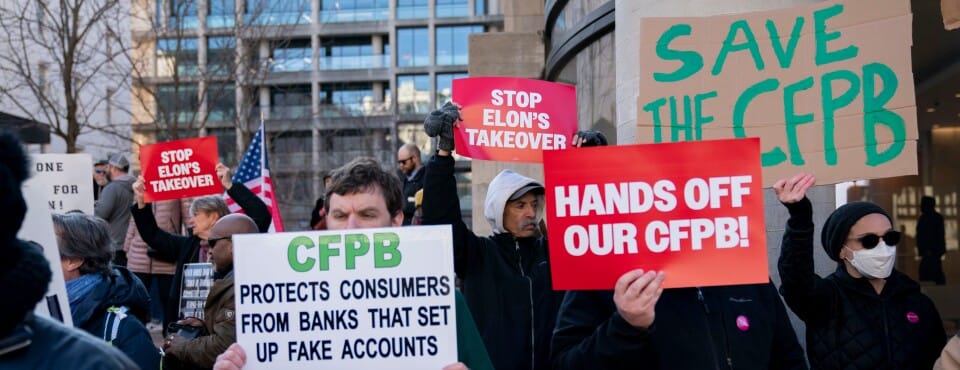
The most detailed picture yet of the CFPB's intended restructuring emerged in late March 2026 from a filing in National Treasury Employees Union v. Vought in the D.C. Circuit. Acting Director Russell Vought's Workforce Restructuring Plan projects 64 total examinations for 2026 — 42 at depository institutions and 22 at non-depository institutions — compared to 107 examinations conducted in 2024.
For the consumer reporting and accounts receivable industries, that reduction has concrete operational implications that go beyond headline numbers about the bureau's internal politics.
What the CFPB Has Said It Will Still Prioritize
The restructuring plan is not a complete withdrawal from FCRA and FDCPA enforcement. The bureau's revised 2025 supervision and enforcement priorities, as reflected in the court filing, explicitly list FCRA and Regulation V data furnishing violations and FDCPA and Regulation F violations as areas the bureau will continue to address.
The plan also indicates the CFPB will focus on cases with "actual intentional discrimination with actual identified victims" rather than statistical disparity analysis. That shift narrows the bureau's fair lending enforcement posture but does not affect its FCRA or FDCPA enforcement authority.
What has changed is volume and scope. Fewer examinations mean fewer opportunities for the bureau to catch systemic violations through the supervisory process before they generate private litigation. Companies that previously relied on exam findings to drive internal remediation cycles will have longer intervals between federal reviews.
The Funding Constraint
The restructuring plan identifies a concrete financial driver. The One Big Beautiful Bill Act, enacted July 4, 2025, reduced the annual cap on CFPB funding transfers from the Federal Reserve from 12 percent to 6.5 percent of the Federal Reserve's 2009 operating expenses adjusted for inflation. That change limits fiscal year 2026 transfers to approximately $466.8 million — below the $677.5 million the bureau states it needs to comply with the preliminary injunction currently keeping more staffing in place than Vought's plan envisions.
The practical implication is that even if the political environment for the CFPB shifts, the funding constraint creates structural limits on the bureau's examination capacity that will persist into 2027 regardless of leadership changes.
State Regulators Are Not Pulling Back
The federal picture obscures a more active state regulatory environment. State attorneys general — particularly in California, New York, Colorado, and Illinois — have indicated they intend to use their consumer protection authority to fill gaps left by reduced federal oversight. Multi-state enforcement coalitions on debt collection and credit reporting practices are a well-established tool that does not depend on CFPB resources.
Companies operating at national scale face a compliance environment that is arguably more complex in 2026 than in prior years — not less. Federal oversight has narrowed in scope but not disappeared. State oversight is expanding. Private litigation is accelerating. The combination requires more sophisticated compliance infrastructure, not less.
This article is for informational purposes and does not constitute legal advice.